
Preheating
Preheat your oven to the temperature specified in your recipe, typically 450 to 500°F for sourdough bread. The oven should be fully preheated before the dough goes in so the bread gets an immediate burst of heat, which helps create good oven spring. If you are using a baking stone, allow additional time for it to fully heat through, as the oven may reach the set temperature before the stone has.
Why is steam important when baking sourdough?
Steam keeps the surface of the dough moist during the early stages of baking, allowing the crust to remain flexible while the bread expands. This helps maximize oven spring and creates a thinner, crispier crust. Once the crust sets, the steam is no longer needed and the bread can brown.
For home ovens without built-in steam injectors, the simplest way to create a steamy environment is to bake the dough in a covered vessel, such as a dutch oven or two bread pans (stainless or nonstick) with one inverted over the other.
The moisture released from the dough becomes trapped inside, creating the steam needed during the initial bake.
Another method is to bake with dutch ovens designed specifically for baking artisan bread. The shallow base makes loading dough easier, while the domed lid and oval shape accommodates larger loaves.
How do you bake sourdough in a covered vessel?
Place the shaped and scored dough into a preheated dutch oven or under an inverted loaf pan and bake covered for the first 20 to 30 minutes. Keeping the vessel covered traps steam and allows the dough to expand before the crust sets.
Remove the lid or cover for the remainder of the bake so the crust can dry out and develop its color and flavor. Continue baking until the loaf reaches an internal temperature of approximately 205 to 210°F, which indicates that the bread is fully baked.
You can take the temperature of your dough with any standard probe thermometer. I prefer using the Taylor Digital Folding Probe Thermometer which takes a reading in a few seconds.
How do you create steam when baking uncovered?
Some breads, such as baguettes, are baked directly on a baking stone and cannot be covered. In this case, steam can be introduced into the oven using a combination of a heat-safe pan, such as a cast iron skillet, filled with water.
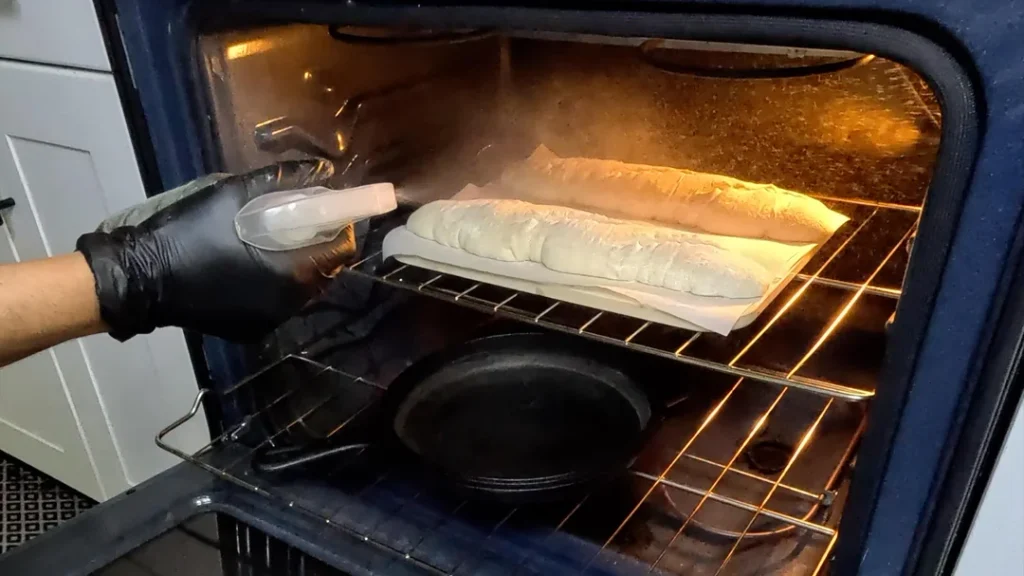
Place the pan on a lower rack and add hot water when the bread goes into the oven. You can also use a spray bottle to quickly spray the sides of the oven with water to create additional steam, taking care to avoid the oven light or glass door.
The goal is to create as much steam as possible during the first 10–15 minutes of baking. After that, the steam can dissipate as the crust sets and the bread continues to brown.
What if the bottom of the bread burns?
If the bottom of your bread is browning or burning before the loaf is fully baked, place an empty baking pan on the rack below the bread. This creates a buffer between the bread and the oven’s lower heating element, reducing the amount of direct heat reaching the bottom of the loaf. You can also move the bread to a higher rack if needed.
How should sourdough cool after baking?
Allow the bread to cool completely on a wire rack before slicing. Elevating the loaf allows air to circulate underneath it and prevents moisture from accumulating against the bottom, which can leave the crust soggy. Cutting into the bread while it is still very hot can cause the crumb to become gummy, so it is well worth giving the loaf time to finish setting before slicing.
For a more precise way to tell when the bread is ready to cut, take its internal temperature with a probe thermometer. Once the center of the loaf has cooled to around 90°F, it is generally cool enough to slice without compressing or making the crumb gummy. Larger loaves may take several hours to reach this temperature, so patience is important.
How should you slice sourdough bread?
Once the dough is cooled, use a serrated bread knife to cut through the crust without crushing the crumb. A gentle back-and-forth motion works better than pressing down and sawing aggressively through the loaf.
If you want evenly sized slices, a bread-slicing guide can make the process much easier. These guides typically use plastic or wooden dividers that hold the loaf in place and give you a channel to follow with your knife, helping keep each slice a consistent thickness.
For an even easier option, lever-style bread slicers hold the loaf in place while a guided blade moves through the bread with a smooth, controlled motion. Because the mechanism provides leverage, slicing requires less effort and hand strength than manually sawing through each loaf, which can be especially useful when cutting several loaves at once.