
What is bulk fermentation?
Bulk fermentation is the dough’s initial rise and fermentation period, which takes place before the dough is divided and shaped. This is different from the final proof, which occurs after shaping. (Refer to my Dividing and Shaping and Final Proofing guide.)
You can bulk ferment your dough in the same bowl you used for mixing or transfer it to a transparent container with measurement markings such as a 2-quart and 4-quart Cambro container. Cover the bowl or container with a lid or another covering, such as a tea towel or shower cap, to keep the dough from drying out.
During bulk fermentation, yeast (or sourdough starter) ferment the sugars in the flour, producing carbon dioxide gas that causes the dough to rise. (Refer to my Sourdough Starter guide to learn more about using a starter.)
Bulk fermentation takes anywhere from 3 to 12 hours. The exact time heavily depends on the temperature of your dough:
- Warm (74°F – 78°F): 2 to 5 hours.
- Moderate (69°F – 73°F): 5 to 7 hours.
- Cold (Below 68°F): 7 to 12 hours.
You can take the temperature of your dough with any standard probe thermometer. I prefer using the Taylor Digital Folding Probe Thermometer which takes a reading in a few seconds.
Also, enriched doughs (adding milk, butter, and eggs) increases the time further.
When is bulk fermentation finished?
There’s no exact amount of time that tells you when bulk fermentation is finished. Temperature, starter activity, hydration, and flour type all affect how quickly your dough ferments. Instead of relying solely on the clock, look for these signs:
- The dough has increased in volume (at least 50%)
- The dough looks smoother and puffier
- You can see bubbles
- The dough feels lighter and elastic
- The dough is jiggly
- The dough has pulled away from the sides
When your dough shows these signs, it’s likely ready for dividing, preshaping, and shaping.
How do I track the rise in volume?
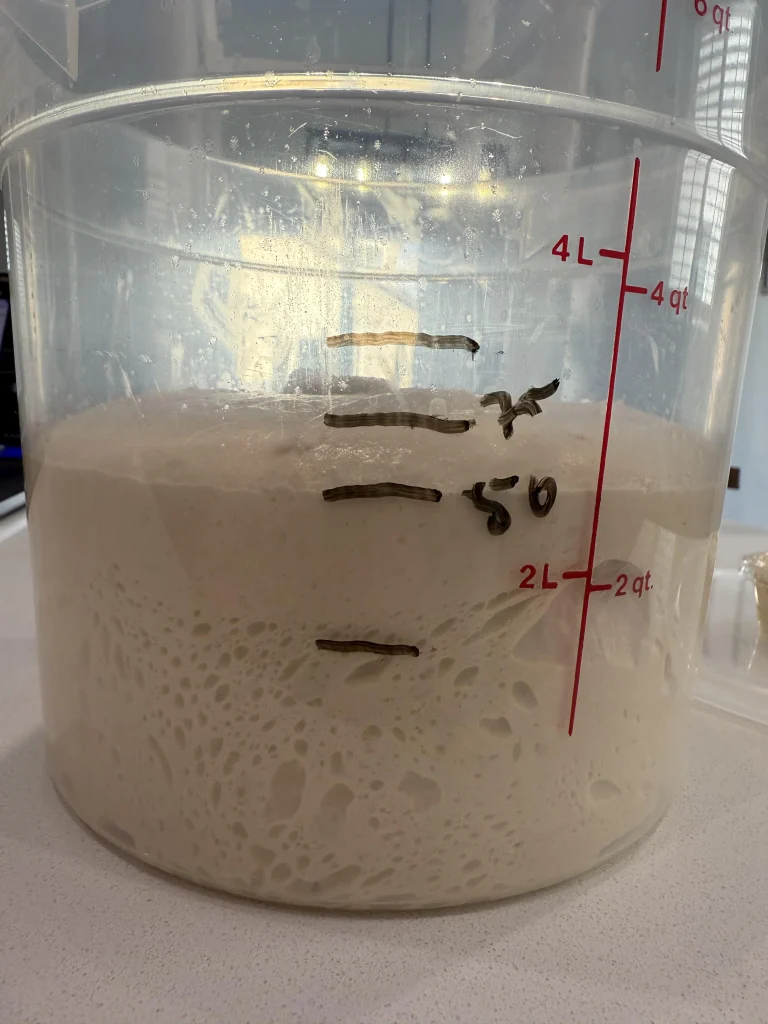
A container with measurement markings makes it much easier to monitor bulk fermentation. I like to use the 2-quart and 4-quart Cambro containers when making one or two loaves of bread, respectively. These containers are transparent and have liter and quart markings which make it easier to measure the increase in volume.
Tip: Mark the dough’s starting level when you begin bulk fermentation. If you’re aiming for a 50% rise, you’ll have a clear visual target for when it’s time to move on.